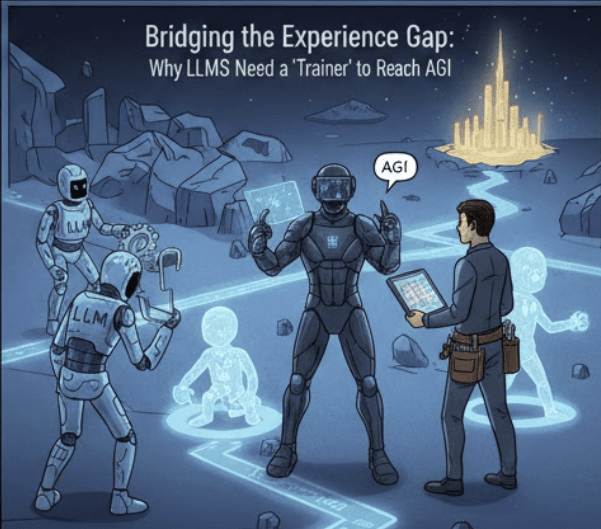
Bridging the Experience Gap: Why LLMs Need a "Trainer" to Reach AGI

Introduction
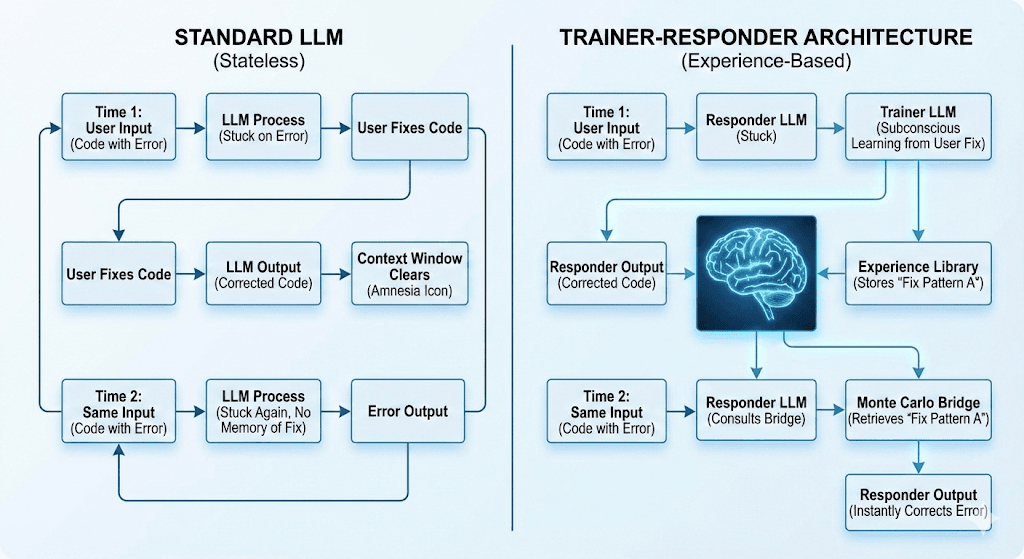
Assume you are "vibe coding," flowing through a project with an AI coding agent. Suddenly, the agent encounters a tricky bug. You step in, guide it through the fix, and resolve the issue. Success. But later, when the exact same type of scenario arises, the agent behaves as if the previous solution never happened. It gets stuck on the same error instead of correcting it.
At that moment, the realization hits you: LLMs are stateless. They might correct a mistake within a specific conversation context, but they never update their actual weights. They don't "learn" from the session; they just predict the next word based on what is immediately in front of them.
While the race for Artificial General Intelligence (AGI) is heating up, this "amnesia" is the wall we are hitting. Models are getting bigger, but they aren't getting smarter at retaining everyday experience. To truly reach AGI—AI that can actually invent new knowledge rather than just recycling the old—we need to move past simple, stateless prediction engines.
The Efficiency Problem: Smart but Inefficient
At their core, current LLMs are statistical prediction engines. They are "proactive" by nature, meaning they jump straight into generating tokens without assessing the complexity or history of the situation. For instance, if you ask an LLM to solve 300 * 756, it might trigger a complex Python script; if you then ask 2 + 3, it often follows that same heavy computational path.
This lack of "situational intuition"—the inability to remember that a specific method failed or succeeded five minutes ago—is the primary barrier to achieving Universal Adaptability. A coding agent shouldn't need to be taught the same lesson twice.
A New Blueprint: The Trainer-Responder Architecture
To solve this, we propose a dual-system approach that mimics human "System 1" (fast) and "System 2" (analytical) thinking:
- The Trainer LLM (The Subconscious): This internal engine doesn't talk to the user. Instead, it "brainstorms" by exploring all possibilities—including negative paths and failures—to learn what works and what doesn't. Crucially, it retains this "muscle memory."
- The Responder LLM (The Conscious Agent): This is the user interface. Before answering, it analyzes the "environment" to see if the query is simple or requires expertise.
- The Monte Carlo Bridge: If the task is complex, the Responder uses Monte Carlo techniques to quickly fetch the most optimal, successful pattern from the Trainer’s "Experience Library" instead of starting from scratch.
Moving Toward True AGI
By adding this layer of "experience," LLMs can finally demonstrate broad cognitive capabilities like learning from past mistakes and abstract reasoning across various fields. Instead of just scaling up training data, this architecture allows models to develop a functional form of "awareness" regarding the tasks they are performing.
In your coding scenario, a Trainer-Responder model would have recorded the first fix in its Experience Library. When the error appeared a second time, it wouldn't stumble; it would simply recall the successful pattern. It transforms the AI from a recycler of human knowledge into a self-learning system capable of mastery without prior specific training.
Conclusion
The path to AGI isn't just about making models larger; it’s about making them wiser. By integrating a Trainer-Responder framework, we allow AI to develop the "intuition" it currently lacks. This shift from raw computation to situational experience is what will ultimately allow machines to invent cures for diseases or discover new laws of physics. We aren't just building a faster engine; we are finally giving the AI a driver’s license.
Call to Action
What do you think? Is "Experience" the missing ingredient for AGI, or is scaling parameters still the way to go? Leave a comment below with your thoughts, or share this post with your favorite AI researcher to start the debate!